Streamline Council Approvals
Avoid costly planning application delays by submitting compliant, professional arborist documentation.
Authoritative AQF Level 5 arborist reports for development planning, Clause 52.37 compliance, and tree risk assessments in White Hills.
Delivering consulting arborist reports across White Hills, Strathdale, and Greater Bendigo.
Our Arborist Report White Hills service provides comprehensive, legally defensible documentation for residential developments, council permit applications, and structural safety audits.
With 816 individual Heritage Overlay entries in Greater Bendigo and 31.8% canopy cover in White Hills, development sites frequently intersect mature exotics and protected remnant eucalypts. A formal AQF Level 5 report resolves permit bottlenecks efficiently.
Avoid costly planning application delays by submitting compliant, professional arborist documentation.
Design building footprints and excavation works accurately around verified Tree Protection Zones.
Obtain certified tree risk documentation for insurance purposes, neighbour boundary discussions, or commercial compliance.
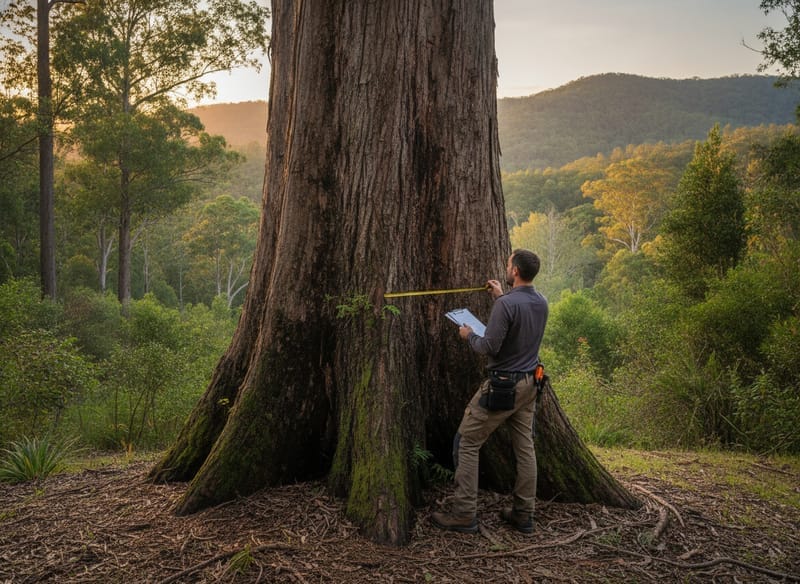
An AQF Level 5 arborist measures trunk diameter (DBH), height, canopy spread, and evaluates biological health.
We calculate accurate Tree Protection Zones in accordance with AS4970-2009 standards.
We cross-reference proposed building plans against tree retention values and local planning overlays.
You receive a comprehensive, structured arborist report ready for submission to the City of Greater Bendigo.
Whether you are planning a new subdivision, extending your home, or managing aging trees on a residential block, securing a professional Arborist Report White Hills is the critical first step. In Bendigo's unique environment, property owners face a complex mix of heritage-listed streetscapes, remnant box ironbark vegetation, and strict local planning overlays. Understanding exactly what you have on your site—and how local council views it—can save you months of frustrating development delays.
Our team at Bendigo Arborist provides fully compliant, highly detailed arborist reports tailored specifically to the City of Greater Bendigo planning scheme. The local landscape presents unique challenges, from the shallow, stony Ordovician sandstone soils that force tree roots into wide, shallow plates, to the hot, dry summers that stress mature exotic canopies.
We bring deep local knowledge and highly qualified consulting arborists to every site assessment. From historic English Elms and native Red Ironbarks to development blocks navigating new canopy tree regulations, we deliver the definitive documentation you need to move your project forward.
A common mistake property owners make during the planning phase is relying on general tree advice or an assessment from an unqualified contractor. The City of Greater Bendigo requires formal tree reports to be prepared by an AQF Level 5 consulting arborist. Submitting a Development Application (DA) or a tree removal permit with a substandard report almost always results in immediate rejection, Requests for Further Information (RFIs), and costly project delays. Furthermore, DIY root mapping or guessing the structural health of a tree is dangerous in this region. White Hills and the wider Bendigo area are characterized by highly reactive, sodic duplex soils with very low permeability. Trees here often develop compromised root systems to cope with the shallow bedrock. Miscalculating a Structural Root Zone (SRZ) on a development site can lead to catastrophic tree failure years after the build is complete, exposing you to severe legal and financial liability. Our AQF Level 5 arborists solve this by providing rigorous, scientifically backed assessments. We conduct precise Visual Tree Assessments (VTA) and calculate accurate Tree Protection Zones (TPZ) in strict accordance with Australian Standards. We take the guesswork out of the council approval process, ensuring your application is supported by defensible, expert data that town planners trust.
When you book an Arborist Report White Hills with us, you receive a comprehensive, legally robust document. Our consulting arborists utilize industry-leading assessment techniques to meet all residential, commercial, and municipal requirements.
Essential for any construction near existing trees. We document species identification, Diameter at Breast Height (DBH), canopy spread, and Safe Useful Life Expectancy (SULE). The report calculates precise Tree Protection Zones (TPZ) and Structural Root Zones (SRZ) under AS4970 to ensure your proposed build does not fatally damage retained trees.
A working document for your builders and trades. This details exactly how trees will be safeguarded during construction, specifying the placement of temporary fencing, trunk armour, mulch layers, and designated 'no-go' zones to prevent soil compaction over the delicate shallow root systems typical of Bendigo.
Utilising Visual Tree Assessment (VTA) methodologies, we evaluate mature trees for structural defects, disease, and decay. This is critical for species prone to sudden limb drop during Bendigo's hot summer afternoons, such as mature River Red Gums. The report documents hazard likelihood, target zones, and mitigation strategies.
Required when seeking a permit to remove a protected tree under council overlays. We provide a comprehensive case detailing why a tree cannot be safely retained, referencing disease, terminal decline, or unacceptable property risk, paired with appropriate replanting recommendations.
Delivering a meticulous Arborist Report White Hills requires a systematic, detail-oriented approach. We manage the entire assessment process from initial consultation to the final PDF handover, ensuring you have exactly what the council or your certifier requires. First, we conduct an in-depth initial consultation. We discuss the specific goals of your project—whether it's a new driveway, a major subdivision, or a safety concern regarding a declining Grey Box tree. We also identify any immediate council triggers, such as the new Clause 52.37 Canopy Trees regulation or local vegetation protection overlays. Next, our AQF Level 5 consulting arborist visits your site. We perform comprehensive field data collection, which includes identifying tree species, measuring the trunk diameter (DBH), assessing the canopy spread, and evaluating overall vigour. We pay special attention to local site constraints, such as the rocky ground or the potential presence of historical mine shaft backfill that might affect root stability. Back at the office, we synthesize this data into a formal, structured report. We calculate all necessary protection zones, draft root mapping recommendations, and formulate a clear retention or removal strategy based on AS4970 and AS4373 standards. Finally, we deliver the signed, fully compliant PDF report directly to you or your town planner, ready for immediate council submission.
Arborist reports are legal documents that carry significant weight in planning tribunals and council chambers. Our consulting arborists hold an AQF Level 5 Diploma of Arboriculture, which is the recognized benchmark for providing authoritative tree advice in Victoria.
Every report we produce strictly adheres to AS4970 Protection of Trees on Development Sites and AS4373 Pruning of Amenity Trees. We carry comprehensive professional indemnity and public liability insurance, ensuring you and your project are fully financially protected. By engaging our fully certified team, you guarantee that your documentation will withstand the scrutiny of the City of Greater Bendigo town planners and private building surveyors.
Writing a successful arborist report in White Hills requires an intimate understanding of the Greater Bendigo Planning Scheme. Unlike other Victorian cities, Bendigo does not have a blanket urban character overlay for exotic trees, nor does it have a functional significant tree register. Instead, regulation is highly targeted.
Native vegetation is fiercely protected. Overlays like VPO1, VPO2, and SLO1 (Significant Landscape Overlay) heavily restrict the removal of remnant box ironbark species, such as Red Ironbark, Grey Box, and Yellow Gum. Additionally, the new state-wide Clause 52.37 requires a permit for removing boundary canopy trees over 5m tall on residential blocks.
Bendigo's Heritage Overlay is genuinely unique; it regularly lists individual trees at specific street addresses. Your property might host a heritage-listed English Elm, a historic Bunya Pine, or a Moreton Bay Fig that requires a highly specialized retention report. Finally, as the entire municipality sits in a bushfire-prone area, we must frequently assess trees against the 10-metre rule for older dwellings. We map all these local nuances before we write a single word.
Once your Arborist Report White Hills has been submitted and your council permit is approved, the physical work can begin. For development sites, you must install the AS4970-compliant tree protection fencing exactly as specified in our report before any heavy machinery arrives on site.
If the report specifies remedial pruning, deadwooding, or a complete removal, our AQF Level 3 climbing arborists can seamlessly execute the job to standard. For mature retained trees, especially during Bendigo's harsh, dry summers, we recommend applying a thick layer of organic mulch within the TPZ and watering deeply. Call us back for a biennial health check to ensure your retained trees are adapting well to any changes in their surrounding environment.
Arborist report fees in White Hills depend on the number of trees surveyed, the complexity of the site, and the reporting depth required.
We supply fixed, upfront quotes based on your architectural drawings and council requirements.
Our consulting arborists provide reports across White Hills and all municipalities within the Greater Bendigo region.
Contact our AQF Level 5 consulting arborists for expert tree reports and council advice.
Get a Free Quote